A mid-rise development on Kingsway in Burnaby recently required soil data before foundation design. The project team needed reliable N-values to estimate bearing capacity and liquefaction potential. That is where the SPT (Standard Penetration Test) delivered. The drill crew advanced a borehole through fill and into the underlying glacial till. Every 1.5 meters, a standard split-spoon sampler was driven 300 mm. The blow counts per 150-mm interval told the story of the ground. For sites underlain by soft sensitive marine clay, the same test is often paired with a vane shear test to capture undrained shear strength in situ. The SPT in Burnaby remains the most widely used in-situ test for foundation design under the British Columbia Building Code.
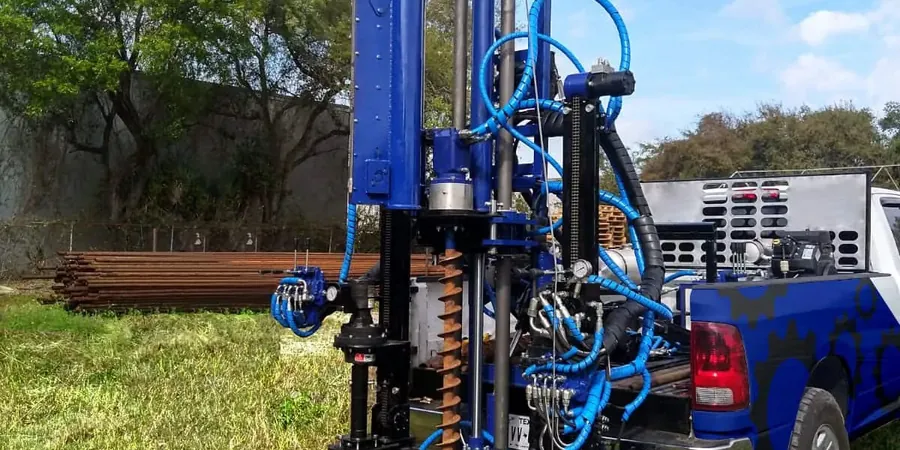
The SPT N-value is the single most correlated index for bearing capacity, liquefaction assessment, and foundation design in Burnaby soils.
Service characteristics in Burnaby
Typical technical challenges in Burnaby
Burnaby recorded a population of over 260,000 in 2023. Much of the city lies within the Fraser River floodplain, where soft soils amplify seismic shaking. A moderate earthquake could trigger liquefaction in saturated sandy layers. The SPT is the primary tool for evaluating this risk. The NCEER method (Youd and Idriss, 2001) uses corrected N-values to map liquefaction potential. Without a proper SPT program, a design team may underestimate cyclic strength. The consequences include differential settlement, foundation rotation, or structural damage. The NBCC 2020 seismic hazard values for Burnaby require site-specific response spectra. Those spectra depend on the SPT-derived N60 profile. Skipping the test means guessing the soil class.
Our services
We offer a full suite of SPT-related services to support your Burnaby project from start to finish.
Borehole Drilling and SPT Execution
Mobilization of track-mounted or truck-mounted rigs. Continuous SPT sampling at 1.5-m intervals or as required. Real-time N-value recording and sample retrieval for lab testing.
Energy Calibration and Hammer Correction
On-site measurement of hammer energy efficiency using instrumented rod. Correction of raw N-values to N60 or N1,60 for consistent liquefaction and bearing capacity analysis.
Data Interpretation and Geotechnical Report
Integration of SPT results with laboratory tests. Development of soil profiles, bearing capacity charts, and settlement estimates. Report compliant with NBCC 2020 and local building department requirements.
Seismic Site Classification
Determination of Site Class (A through F) per NBCC 2020 using average N60 in the upper 30 m. Recommended for liquefaction assessment and ground response analysis in Burnaby.
Frequently asked questions
How much does an SPT test cost in Burnaby?
The typical cost for an SPT borehole including drilling, sampling, and field logging in Burnaby ranges from CA$810 to CA$880 per test location. Volume discounts apply for multiple boreholes. The final cost varies with depth, access conditions, and the need for energy correction.
What is the difference between N-value and corrected N60?
The raw N-value is the blow count recorded in the field. N60 corrects that value to a standard energy ratio of 60%. This correction is essential for liquefaction analysis and bearing capacity correlations because hammer efficiency varies between rigs. Most design standards in Canada require N60.
Can SPT be performed in Burnaby's soft marine clay?
Yes, but the blow counts will be low, often between 1 and 5. In very soft clay, the sampler may penetrate under its own weight. In those conditions, the test still provides useful data, but the vane shear test is often run alongside to measure undrained shear strength directly.
How deep should an SPT borehole go for a typical Burnaby project?
For a low-rise building, 10 to 15 meters is common. For mid-rise or high-rise structures, depths of 20 to 30 meters are needed to reach competent till or to assess liquefiable layers. The NBCC 2020 requires the top 30 m for seismic site classification.