In Burnaby, we often find that the deep glacial till deposits overlying softer marine clays create a complex seismic signature. A standard peak ground acceleration value from the NBCC code isn't enough when you are building near the Burnaby Lake area or along the slopes of Burnaby Mountain. That is why our team runs a proper site response analysis in Burnaby for every project that touches these variable soil profiles. We look at the actual vs30/" data-interlink="1">shear wave velocity profile, typically using MASW or downhole methods, to see how the ground will shake. This is not a generic desk study; we model the specific column of soil under your site. Before we run the seismic model, we often verify the stiffness profile with an ensayo SPT to correlate blow counts with strain-dependent modulus degradation curves. It gives us the ground truth we need for the analysis.
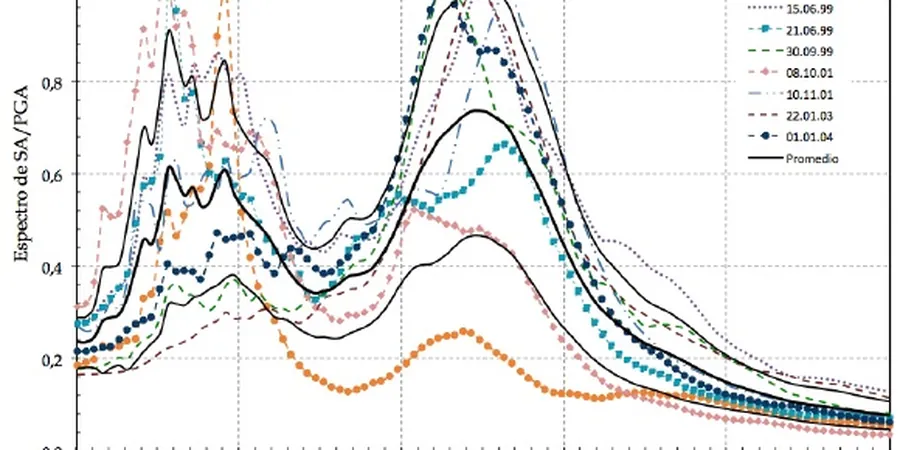
We propagate design-level ground motions through Burnaby's actual soil column to output the surface response spectra your structural engineer needs.
Service characteristics in Burnaby
Typical technical challenges in Burnaby
We set up the seismograph at the borehole collar and lower the triaxial geophone down the PVC casing. The energy source is a sledgehammer or a controlled weight drop at surface. On a typical Burnaby site, the biggest challenge is getting a strong enough signal through the dense till to the sensor at depth. If the coupling is poor or the casing is grouted badly, the wave arrival is noisy and the travel time picks are unreliable. We always check the waveform quality in real time on the oscilloscope before moving to the next depth. A bad trace means we repeat the shot. It is tedious work, but the vs30/" data-interlink="1">shear wave velocity profile is the backbone of the whole site response analysis in Burnaby. Without clean data, the seismic model is just a guess.
Our services
We offer a complete suite of seismic site characterization services in Burnaby, from field testing to final engineering analysis.
MASW & Vs30 Profiling
Multichannel Analysis of Surface Waves to determine the average vs30/" data-interlink="1">shear wave velocity in the top 30 meters. This directly defines the site class for NBCC and provides the velocity profile needed for site response analysis.
Downhole Seismic Testing
P-S suspension logging or conventional downhole tests in cased boreholes. We obtain discrete vs30/" data-interlink="1">shear wave velocities at 1-meter intervals, giving a detailed profile of stiffness with depth.
One-Dimensional Ground Response Analysis
Equivalent linear and non-linear wave propagation modeling using DEEPSOIL or SHAKE. We output surface acceleration time histories and response spectra compatible with NBCC 2020 design spectra.
Frequently asked questions
What is the difference between a site response analysis and a standard geotechnical report?
A standard geotechnical report provides soil bearing capacity, settlement, and general recommendations. A site response analysis specifically models how the soil column amplifies or de-amplifies earthquake ground motions. It produces surface acceleration spectra that the structural engineer uses directly for seismic design of the building. Without it, you are using generic code-based site factors that may not reflect the actual soil layering in Burnaby.
How does the deep glacial till in Burnaby affect seismic amplification?
The dense till has high vs30/" data-interlink="1">shear wave velocity, typically above 600 m/s, so it tends to pass higher frequency motions without much amplification. However, the softer marine clays and organics above it can trap and amplify lower frequency motions. This creates a two-layer system where the transition between soft and stiff soil controls the dominant period of shaking. Our analysis captures this frequency-dependent behavior.
How much does a site response analysis cost in Burnaby?
The cost typically ranges between CA$1.530 and CA$6.520 depending on the depth of profiling required, the number of input motions, and whether we run a 1D or 2D analysis. For a standard mid-rise building on a single borehole with MASW, you are usually in the lower half of that range. Complex sites with multiple boreholes or deep profiles push it higher.
What input ground motions do you use for the analysis?
We use the Uniform Hazard Spectra (UHS) from the NBCC 2020 seismic hazard model for Burnaby. We select and scale a suite of real earthquake records to match the target spectrum across the period range of interest (typically 0.1 to 2 seconds). We also check compatibility with the site class to ensure the records are appropriate for the local soil conditions.