In Burnaby, the drill rigs working on deep excavation sites often sit within a few hundred meters of the buried glacial till or the sensitive marine silts of the Fraser River delta. The machinery—track-mounted hydraulic rigs and CFA piling units—must contend with a stratigraphy that shifts from dense sands to soft clays within a single borehole. For any project involving basement levels, utility tunnels, or elevator pits, the geotechnical design of deep excavations must address lateral earth pressures, groundwater control, and basal heave. A thorough site investigation, including a detailed classification of soils to identify the exact stratigraphy, is the first step before any shoring layout is proposed.
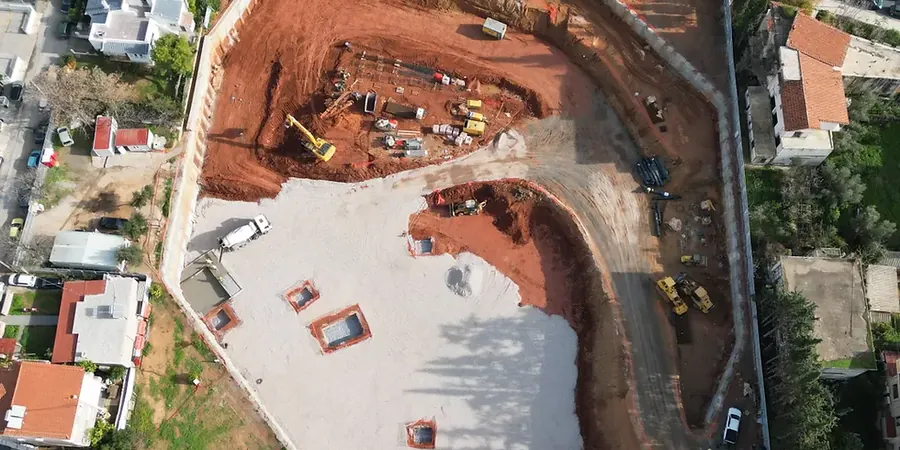
The shift from dense glacial till to soft marine clay within 10 meters is the defining challenge for any deep excavation design in Burnaby.
Service characteristics in Burnaby
Typical technical challenges in Burnaby
A practical observation from Burnaby sites: the transition from the glacial till crust to the underlying marine clay can happen abruptly, often at depths of 8 to 12 meters. If the shoring design assumes a uniform soil profile but encounters a soft clay layer instead, basal heave and wall deflection become immediate concerns. The geotechnical design of deep excavations must include a probabilistic assessment of stratigraphic variability. We also see that dewatering in the till lenses can cause settlement of adjacent buildings if not monitored with piezometers and inclinometers. A phased excavation sequence with real-time instrumentation is non-negotiable in Burnaby's urban corridors.
Our services
Our team provides two core services tailored to Burnaby's deep excavation demands, from concept design through construction support.
Shoring & Excavation Support Design
Design of soldier pile and lagging, secant pile walls, and anchored systems for excavations up to 18 m deep. We calculate lateral earth pressures per Rankine and Coulomb theories, apply surcharge loads from adjacent traffic and structures, and verify stability under seismic conditions using NBCC 2020 response spectra.
Dewatering & Groundwater Control
Hydrogeological assessment using pumping tests and finite element seepage models. We design wellpoint systems, deep wells, and cutoff walls to maintain dry subgrade during excavation. Drawdown predictions are calibrated against the hydraulic conductivity of Burnaby's till and sand layers.
Frequently asked questions
How is the geotechnical design of deep excavations affected by Burnaby's glacial till?
Glacial till in Burnaby is typically a very dense, low-permeability material that provides excellent bearing but can contain boulders. The design must account for its high friction angle (38-45 degrees) and the potential for trapped water pockets. Where till overlies softer marine clay, the excavation support must be designed as a cantilever or with tiebacks to prevent wall rotation.
What are the typical costs for a deep excavation design in Burnaby?
The cost for a comprehensive geotechnical design of deep excavations in Burnaby ranges between CA$2.690 and CA$11.530, depending on excavation depth, wall type, dewatering complexity, and the level of instrumentation required. A detailed site-specific quotation is recommended after the soil investigation is completed.
What seismic considerations are unique to deep excavations in Burnaby?
Burnaby is in a high seismic zone near the Cascadia subduction zone. The design must include site-specific response spectra per NBCC 2020, evaluate liquefaction potential of loose sand layers, and check the stability of shoring walls under earthquake-induced lateral pressures. A pseudo-static analysis with horizontal acceleration coefficients of 0.2g to 0.3g is typical.