Driving along Kingsway through the Metrotown area, you feel a smooth ride, but head up toward the Burnaby Mountain slopes near SFU and the pavement tells a different story. The contrast between the deep glacial till under the flats and the weathered sandstones on the slopes means flexible pavement design in Burnaby has to adapt block by block. We see it every time we dig test pits for a new road or parking lot project. The soil changes, the drainage changes, and the design has to follow. That is why our approach combines a study of soil classification to identify the material type with a plate load test to measure the actual bearing capacity at subgrade level. Getting those two numbers right early saves a lot of asphalt later.
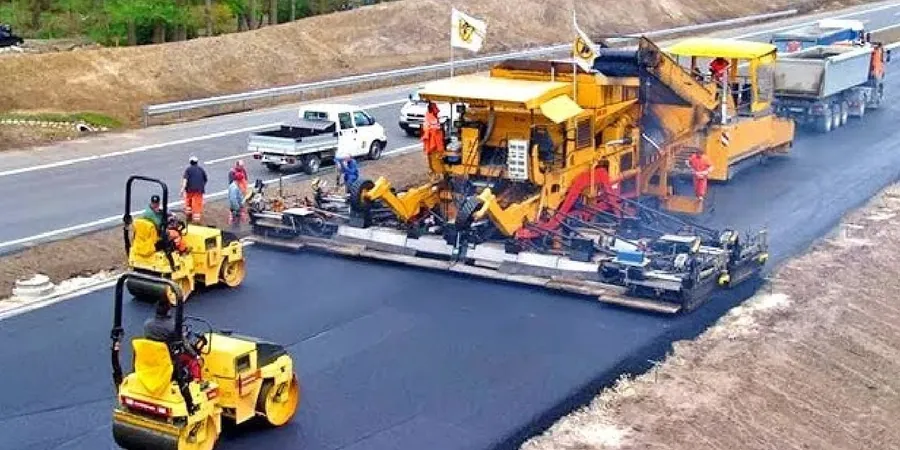
We run soaked and unsoaked CBR on every Burnaby subgrade because the difference between summer and winter moisture can cut bearing capacity by half.
Service characteristics in Burnaby
- Modified Proctor (ASTM D1557 (also CFEM Ch 2) (also CFEM Ch 2) (also CFEM Ch 2) (also CFEM Ch 2) (also CFEM Ch 2)) to establish optimum moisture and maximum dry density
- CBR on soaked and unsoaked samples to simulate both dry summer and wet winter conditions
- Resilient modulus correlation via triaxial testing when the traffic class exceeds 1 million ESALs
Typical technical challenges in Burnaby
In Burnaby, many times we see pavement failures that trace back to one oversight: ignoring the perched water table that sits above the till layer after heavy rain. The soil might test fine in August, but come November the subgrade is saturated and the structural number drops fast. A flexible pavement design that does not account for this seasonal moisture fluctuation will fail at the edges first, then migrate inward. We always check the drainage path and, when needed, recommend a capillary break or daylighting before placing the base course. That extra step costs little upfront but saves the entire pavement structure from water damage.
Our services
We support flexible pavement design in Burnaby with three core field and lab services tailored to local soil conditions.
Subgrade Investigation and Sampling
Test pits and boreholes to classify soil layers, collect undisturbed and bulk samples, and measure in-situ density. We target the top 1.5 m where the pavement structure interacts with the natural ground.
CBR and Resilient Modulus Testing
Soaked and unsoaked CBR per ASTM D1883, plus Mr correlation via triaxial testing. Results feed directly into the AASHTO structural number calculation for flexible pavement design in Burnaby.
Pavement Thickness Design Report
We deliver a full design memo with layer thickness recommendations, drainage notes, and compaction specifications. The report references Burnaby-specific soil data and traffic assumptions provided by the client.
Frequently asked questions
What CBR value is typical for Burnaby subgrade soils?
Burnaby subgrade ranges from CBR 2% in soft organic deposits near the Fraser River to CBR 8% in dense glacial till found across the central plateau. We always test soaked samples because the seasonal moisture increase can drop the value by 40% or more.
How much does flexible pavement design testing cost in Burnaby?
For a standard road or parking lot project, the cost typically falls between CA$2,590 and CA$7,460 depending on the number of test pits, traffic class, and whether resilient modulus testing is required. We provide a fixed quote after reviewing the site scope.
Do you use the AASHTO 1993 method or a mechanistic-empirical approach?
We use the AASHTO 1993 guide as the primary method because it aligns with local municipal specifications in Burnaby. For projects over 2 million ESALs, we supplement it with a mechanistic-empirical check using the AASHTOWare Pavement ME software to verify fatigue and rutting performance.