The coastal rainfall in Burnaby exceeds 1,200 mm per year, saturating the region's glacial till and marine clay deposits. Loose sand lenses beneath Metrotown and along the Fraser River shoreline often lack the density needed to support moderate to heavy loads without excessive settlement. Vibrocompaction design in Burnaby addresses this by densifying granular soils through deep vibration, reducing void ratios and increasing relative density above 70%. Before mobilizing the vibroflot, we always run a study of densification potential using cone penetrometer to map the exact depth and distribution of loose zones. This data informs the probe spacing and energy input required to meet the project's post-compaction acceptance criteria.
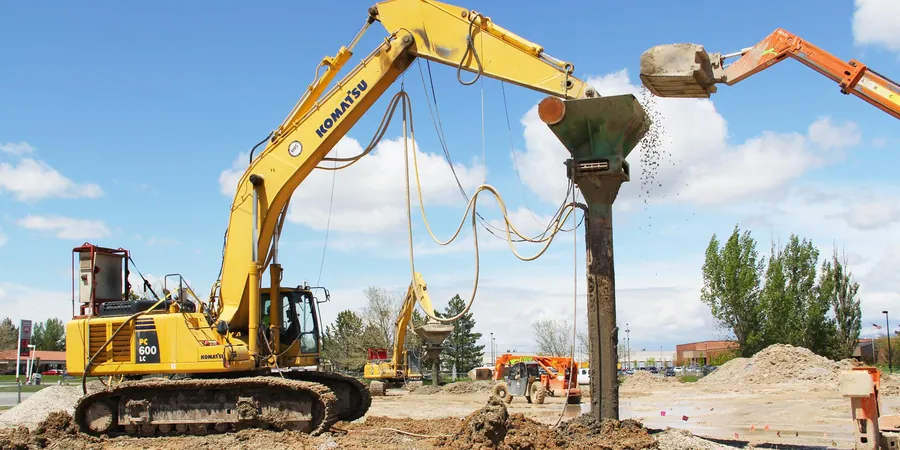
In Burnaby's loose sands, increasing relative density from 45% to 75% cuts liquefaction risk by roughly 80% under a magnitude 7 event.
Service characteristics in Burnaby
- Relative density (Dr): target ≥ 75% for non-liquefiable conditions under the design earthquake (475-year return period).
- Cone tip resistance (qc): we use CPT readings to verify that qc exceeds 10 MPa in the treated zone.
- Settlement modulus (M): derived from plate load tests to confirm immediate and creep settlement stay within 25 mm total.
Typical technical challenges in Burnaby
Comparing the Brentwood–Lougheed corridor to the Capitol Hill area reveals a stark contrast. Brentwood sits on deep alluvial sands where vibrocompaction design in Burnaby works efficiently, while Capitol Hill's glacial till is too dense to need treatment. The real risk lies in the transition zones along Still Creek — loose silty sands interbedded with soft clay. If the vibrocompaction design ignores the clay lenses, pore pressure dissipation stalls and the ground may heave instead of densify. We always cross-check stratigraphy with CPTu dissipation tests to confirm drainage conditions before setting probe patterns.
Our services
Beyond standard vibrocompaction design, we offer complementary ground improvement services tailored to Burnaby's variable subsurface conditions.
Vibrocompaction with Real-Time CPT Verification
Post-compaction CPT soundings at every fifth probe location to confirm that qc and relative density meet the design target. We provide a written certification report within 5 working days.
Pre-Loading and Surcharge Design Integration
When soft clay layers overlie the sand target zone, we design a staged surcharge (up to 80 kPa) that consolidates the clay before vibrocompaction, preventing pore pressure buildup and soil heave.
Seismic Site Response Analysis
Using the post-compaction shear-wave velocity (Vs) profile from MASW or downhole seismic, we run 1D site response analysis per NBCC 2020 to verify that the treated ground reduces spectral acceleration at the foundation level.
Frequently asked questions
How much does vibrocompaction design typically cost for a Burnaby site?
For a standard residential or light commercial lot in Burnaby, the design and verification package ranges between CA$2,080 and CA$8,100. This includes the initial CPT survey, probe layout plan, post-compaction testing, and a stamped certification report. Larger sites or those requiring deep treatment (over 12 m) fall at the upper end.
What soil conditions in Burnaby require vibrocompaction versus other methods?
Vibrocompaction works only in clean to slightly silty sands (fines content below 15%). In Burnaby's marine clay zones or peat deposits along Deer Lake, we recommend deep soil mixing or preloading with vertical drains instead.
Can vibrocompaction design reduce liquefaction risk under the NBCC 2020 earthquake?
Yes. When post-treatment relative density reaches 75% or higher, the factor of safety against liquefaction typically exceeds 1.5 for a 475-year event. We run the Youd-Idriss (2001) method using post-compaction CPT data to confirm compliance.
How long does the vibrocompaction design process take from site investigation to final report?
Typically 3 to 4 weeks. The first week covers field CPT and SPT borings, the second week is for probe layout and parameter selection, and the final week includes post-compaction testing and report writing. Tight schedules can be compressed to 2 weeks with advance mobilization.
Does vibrocompaction affect adjacent structures or utilities in Burnaby's dense neighborhoods?
Vibration levels at distances beyond 5 m usually stay below 12 mm/s PPV — well under the NBCC threshold for damage. We still recommend pre- and post-condition surveys for buildings within 10 m of the treatment zone, especially around older masonry structures in the Edmonds area.