Burnaby sits on the Fraser River delta sequence with 1,200 meters of Quaternary sediments overlying bedrock. This thick sedimentary package, combined with the region's high seismic hazard (design spectral acceleration Sa(0.2) ~0.7 g per NBCC 2020), makes subsurface velocity characterization essential. We deploy 24-channel seismographs with 4.5 Hz geophones along 150 m spreads to generate P-wave and S-wave velocity models down to 50 m depth. The resulting tomography profiles directly inform site class assignment (A through F) and liquefaction triggering analysis. Before mobilizing the seismic line, we often cross-reference with a MASW survey to validate the near-surface vs30/" data-interlink="1">shear wave velocity layer. This dual-method approach reduces ambiguity in the velocity inversion and improves confidence in the final geotechnical model for Burnaby projects.
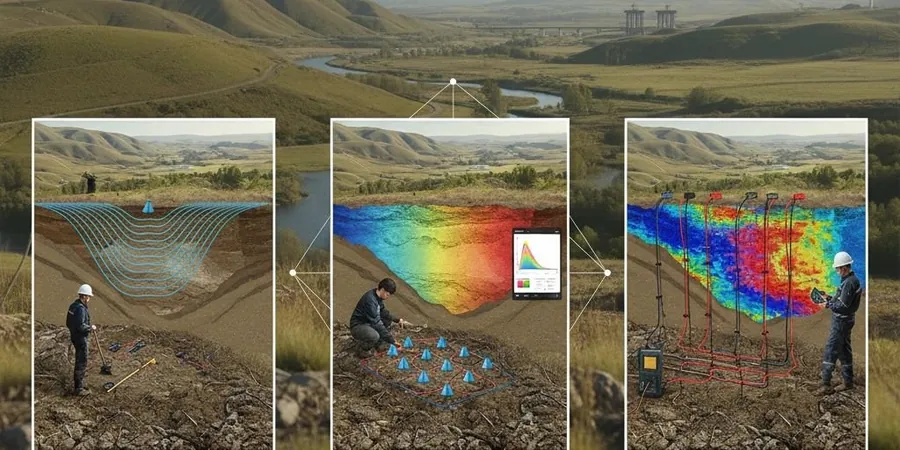
Shear wave velocity profiles from seismic tomography directly define NBCC 2020 site class, controlling design spectral acceleration for every Burnaby project.
Service characteristics in Burnaby
- P-wave velocity (Vp) profiles for bedrock depth and rippability assessment
- Shear wave velocity (Vs) models for NBCC site class and ASCE 7-22 site coefficients
- Poisson's ratio and elastic modulus from combined Vp/Vs interpretation
- Reflection horizons for stratigraphic layer dip and fault detection
For deep foundations or tunnel alignments in Burnaby, we combine seismic tomography with precarga y sobrecarga data to verify consolidation behavior under seismic loading. The inverted velocity fields are validated through borehole geophysical logs and crosshole seismic checkshots where available.
Typical technical challenges in Burnaby
NBCC 2020 requires site-specific vs30/" data-interlink="1">shear wave velocity profiles for any structure in Seismic Site Class C, D, E, or F. Burnaby's deep soil profile — up to 1,200 m of deltaic sands, silts, and clays — amplifies long-period ground motions. Without accurate Vs30 from seismic tomography, designers risk underestimating spectral accelerations by 30–50% at periods above 0.5 s. For slopes along Burnaby Mountain and the Fraser River bluffs, refraction tomography identifies weak layers and potential failure planes that standard SPT borings miss entirely. We follow ASTM D5777 and NBCC 2020 commentary to ensure the velocity model captures the critical impedance contrasts that control seismic response.
Our services
We provide three specialized seismic tomography services adapted to Burnaby's geological conditions and project needs.
Refraction Tomography (2D)
Covers 150 m spreads for bedrock depth, rippability, and Vs30. Used for building foundations, bridge piers, and seismic site class assignments.
Reflection Tomography (2D/3D)
High-resolution imaging of stratigraphic layers, faults, and paleochannels. Ideal for tunnel alignments, deep excavations, and landslide investigations.
Combined Refraction-Reflection
Simultaneous acquisition for both shallow (2–30 m) and deep (30–80 m) velocity profiles. Reduces uncertainty in the inversion model and provides the most complete subsurface picture.
Frequently asked questions
What depth can refraction seismic tomography achieve in Burnaby soils?
With a 150 m spread and 6 kg sledgehammer, we reliably image down to 50 m depth. For deeper targets (up to 80 m), we deploy a 30 kg drop weight and 300 m spread. The maximum depth is controlled by the source energy and the velocity contrast at the target horizon.
How does seismic tomography differ from MASW for Vs30 determination?
MASW uses surface wave dispersion to invert for a 1D Vs profile, while refraction tomography uses first-arrival travel times to build a 2D velocity cross-section. Refraction resolves lateral velocity changes (e.g., paleochannels, fault zones) that MASW may smear. For NBCC site class, we often run both methods and cross-validate.
What is the typical turnaround time for a seismic tomography survey in Burnaby?
Field acquisition takes 1–2 days for 4–6 profiles. Data processing and inversion (using Rayfract or SeisImager) require 3–5 business days. The final report includes velocity contour plots, interpreted bedrock depth, Vs30, and site class per NBCC 2020.
How much does a refraction seismic tomography survey cost in Burnaby?
The typical range is between CA$3,650 and CA$8,040 depending on spread length, number of profiles, and access conditions. This includes mobilization, field crew, data processing, and a detailed interpretative report. Larger projects with multiple spreads may qualify for volume discounts.