Burnaby sits on a mix of glacial till, marine silts, and organic deposits left by retreating ice sheets. The glacial till near Capitol Hill offers good bearing, but the lowland areas around Deer Lake and Burnaby Lake have soft compressible clays up to 20 meters thick. For projects on those weaker soils, the geogrid specification becomes a critical design step. We define the required tensile strength, junction efficiency, and creep-limited load based on the subgrade CBR and the fill height. Before finalizing the geogrid specification, our team often runs a plate load test to confirm the subgrade modulus, which directly affects the grid's required stiffness.
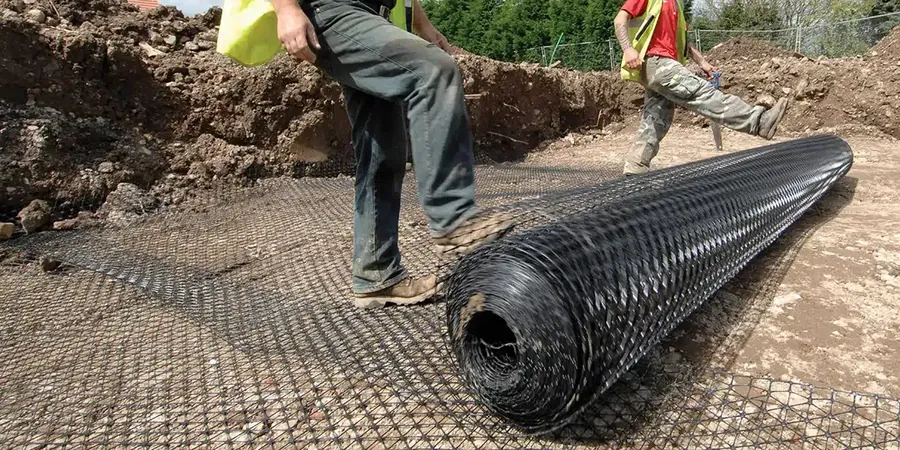
In Burnaby's soft clays, the geogrid specification often governs the pavement design life more than the asphalt thickness itself.
Service characteristics in Burnaby
Typical technical challenges in Burnaby
Using a roller compactor on a grid that wasn't specified for Burnaby's angular glacial till can shred the ribs before the first lift is placed. We've seen it happen. The geogrid specification needs to include the installation damage reduction factor derived from local testing, not generic values. A grid that passes a standard index test may still fail at the junction when hit by a vibratory roller on sharp till. If the geogrid specification ignores the subgrade's stiffness variation across the site, differential settlement can rupture the grid along the boundary between till and soft clay. That's why we always correlate the geogrid specification with the actual soil profile from test pits.
Our services
We provide the full chain of services around geogrid specification and installation support in Burnaby. Our lab is ISO 17025 accredited and our field team has worked on Metro Vancouver's most challenging soft-ground sites.
Geogrid Design & Specification Review
We review your project's subgrade conditions and write a detailed geogrid specification including tensile strength, junction efficiency, creep limits, and installation damage factors. We follow ASTM D6637 and GRI-GG2 test methods. The deliverable includes a specification sheet ready for tender documents.
On-Site Geogrid Verification & Quality Control
During installation our technicians verify roll placement, overlap widths, and anchorage. We sample grid coupons for index testing and compare results against the geogrid specification. We also perform post-installation proof rolling to confirm the reinforced layer meets the design modulus.
Frequently asked questions
How much does a geogrid specification study cost in Burnaby?
The typical range for a complete geogrid specification study in Burnaby is CA$550 to CA$1,600. This includes site review, lab testing of the grid, and a written specification. Larger projects with multiple zones or complex fill conditions may reach the upper end.
What is the difference between uniaxial and biaxial geogrids?
Uniaxial grids have high tensile strength in one direction and are used for retaining walls and steep slopes where the main load is horizontal. Biaxial grids have balanced strength in both directions and are used for base reinforcement on weak subgrades, which is the common case in Burnaby's soft clay areas.
Do I need a geotextile under the geogrid in Burnaby soils?
Yes, in most Burnaby sites with silty or clayey subgrades a separation geotextile is required below the grid. Without it, fine particles pump up through the grid apertures during compaction, reducing the aggregate interlock that gives the geogrid its reinforcing effect.
What is junction efficiency and why does it matter?
Junction efficiency is the ratio of the strength at the rib junction to the strength of the rib itself. A low junction efficiency means the grid can fail at the node before the rib reaches its full capacity. For load-bearing applications, we specify a minimum of 93% per GRI-GG2.
How long does a geogrid specification take to complete?
A standard geogrid specification for a Burnaby project takes 5 to 10 business days from the time we receive the subgrade investigation report. If we need to do additional field testing or send grid samples to the lab, add another week.