Burnaby's location on the Pacific coast means heavy rainfall and steep terrain define the local geology. The city receives over 1,200 mm of precipitation annually, saturating glacial till and marine sediments that cap many residential and commercial lots. Without a proper soil erosion analysis, stormwater runoff can quickly undercut building pads and destabilize cut slopes. We combine field infiltration tests with laboratory dispersion testing to quantify erodibility. When the site involves fine-grained soils, we also recommend a permeability field test to measure actual flow rates through the soil mass, while a drainage geotechnical study helps design surface water controls that prevent rill and gully erosion.
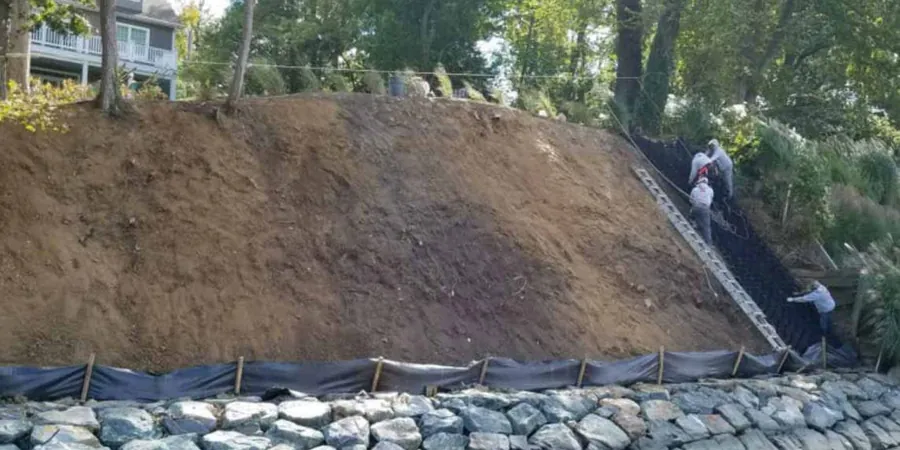
In Burnaby's rainy climate, unchecked erosion can remove up to 30 cm of topsoil in a single winter season, exposing foundations to scour and undercutting.
Service characteristics in Burnaby
- RUSLE-based modeling calibrated to local rainfall data
- Pinhole dispersion and double-hydrometer tests per ASTM D4647 and D4221
- Slope stability cross-sections that incorporate erosion-induced geometry changes
Demonstration video
Typical technical challenges in Burnaby
The National Building Code of Canada (NBCC 2020) requires that all excavations and fills be designed to prevent erosion during and after construction. In Burnaby, where the coastal bluffs along the Fraser River can retreat several centimeters per year, ignoring erosion analysis can lead to property line disputes and structural damage. The City of Burnaby's Subdivision and Development Bylaw explicitly mandates erosion and sediment control plans for any site with more than 0.5 hectares of disturbed area. ASTM D4647 (pinhole test) is the standard we apply to identify dispersive clays that pipe internally under seepage — a hidden risk many local engineers overlook.
Our services
We offer a complete suite of soil erosion analysis services tailored to Burnaby's challenging terrain and municipal requirements. Each service is executed under ISO 17025 quality management and reported with clear recommendations for erosion control design.
Erosion Risk Assessment & RUSLE Modeling
We compute the Revised Universal Soil Loss Equation (RUSLE) using site-specific rainfall, soil type, slope geometry, and land cover data. The output quantifies annual soil loss in tonnes per hectare and identifies critical zones requiring immediate protection.
Dispersion & Pinhole Testing for Internal Erosion
Using ASTM D4647 pinhole tests and ASTM D4221 double-hydrometer analysis, we determine whether the soil is dispersive — prone to piping and tunnel erosion under seepage. This is crucial for Burnaby's silt-rich glacial deposits.
Erosion & Sediment Control Plan (ESCP) Design
We prepare site-specific ESCPs that comply with Burnaby's bylaws and Metro Vancouver's stormwater regulations. Plans include silt fence placement, sediment basin sizing, check dam spacing, and temporary seeding specifications.
Frequently asked questions
How does soil erosion analysis differ from a standard geotechnical investigation?
A standard geotechnical investigation focuses on bearing capacity and settlement for foundations. Soil erosion analysis specifically quantifies surface and internal erosion potential using runoff modeling, dispersion tests (ASTM D4647, D4221), and erodibility factors. It answers how much soil will be lost per year and where erosion control measures are most critical.
What is the typical cost range for a soil erosion analysis in Burnaby?
The cost for a complete soil erosion analysis in Burnaby typically ranges between CA$1.130 and CA$3.710, depending on site size, number of test pits, laboratory tests required, and the complexity of the erosion and sediment control plan. Contact us for a firm quote based on your specific project scope.
How long does a soil erosion analysis take from site visit to final report?
Most erosion analyses are completed within 7 to 14 business days. Fieldwork including infiltration tests and soil sampling usually takes one day. Laboratory dispersion and pinhole tests require 3 to 5 days, followed by modeling and report production. For large subdivisions with multiple test pits, the timeline may extend to 3 weeks.