A portable dynamic cone penetrometer and a set of thin-walled Shelby tubes are the first tools deployed when the team arrives at a Burnaby site underlain by residual soils. These weathered profiles, common along the slopes of Burnaby Mountain and the glacial till remnants of the Fraser Lowland, require careful sampling because their fabric collapses easily if disturbed. The driller advances a 76-mm split spoon for Standard Penetration Testing, though the energy correction for the automatic hammer must be verified against ASTM D4633 before each run. Each recovered sample is logged on-site for moisture, colour changes indicating oxidation fronts, and the presence of relict rock structure. The material is then sealed and transported to the laboratory for index property tests that define the engineering behaviour of these transitional soils.
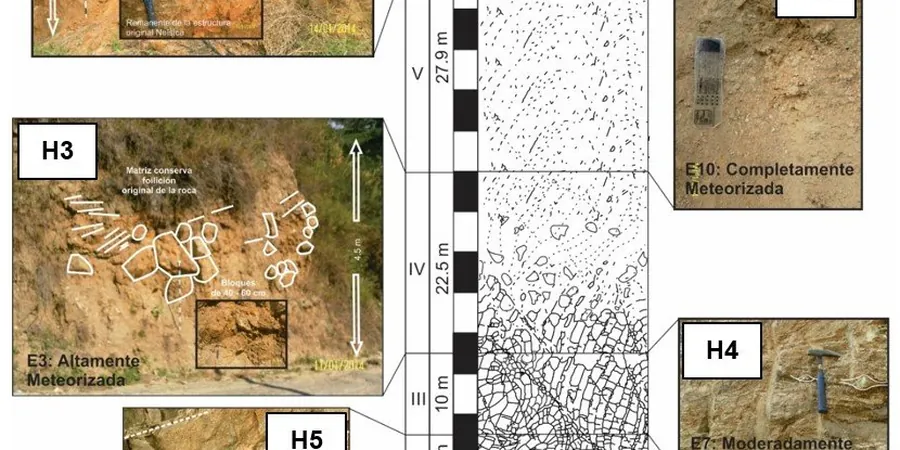
Residual soils in Burnaby can lose 60% of their intact stiffness within the first metre of weathering — proper characterization is the only way to capture that decay.
Service characteristics in Burnaby
Typical technical challenges in Burnaby
A four-storey residential building on Burnaby’s Capitol Hill slope was founded on residual soil classified as Grade V. The geotechnical report relied on N-values from SPT tests, but the design ignored the loss of cementation once the soil was exposed during excavation. Within two weeks of cutting the slope, tension cracks appeared along the back of the pad footing. The scenario illustrates a classic risk: residual soils exhibit brittle stress-strain behaviour that conventional laboratory tests on remoulded samples miss. For Burnaby’s hillside developments, the team now recommends block sampling and triaxial testing on undisturbed specimens to capture the true peak strength and the post-peak degradation that governs stability under seismic loading.
Our services
Our Burnaby residual soil characterization services are tailored to the city’s unique weathering profiles and the requirements of local building officials.
Saprolite Profile Mapping
Detailed logging of weathering grades from hand-auger borings and test pits, with photographic records of relict structures. We produce depth-to-bedrock contours and iso-weathering maps that help engineers decide where to transition from shallow to deep foundations.
Index & Strength Testing on Residual Specimens
Atterberg limits, natural moisture content, and total suction measurements on undisturbed block samples. For strength, we run multistage triaxial tests (UU and CIU) at confining pressures that match the in-situ effective stress range typical of Burnaby’s upper slope deposits.
Frequently asked questions
What makes residual soil characterization different from testing transported soils?
Residual soils retain the fabric, joints, and mineralogy of the parent rock. Standard compaction-based testing on remoulded samples does not capture the cemented structure or the rapid strength loss upon saturation. Characterization must include undisturbed sampling, suction measurements, and recognition of relic discontinuities that act as preferential slip planes.
How does the degree of weathering affect foundation design in Burnaby?
Grade V and Grade VI soils have very low cohesion and can collapse under heavy machinery. The NBCC 2020 site class shifts from C to D or even E if the residual profile exceeds 10 m. Foundations must be designed for reduced bearing capacity, and often require deepened footings or ground improvement to reach Grade III material.
What is the typical cost range for a residual soil characterization study in Burnaby?
A full characterization program including two boreholes to 6 m depth, SPT, undisturbed sampling, index tests, and one triaxial series generally falls between CA$1.030 and CA$3.780. The range depends on site accessibility, the number of weathering grades encountered, and whether block sampling on steep slopes is required.
Can residual soils in Burnaby be used as engineered fill after excavation?
It depends on the degree of weathering. Grade IV and V soils can be recompacted to achieve 95% of Standard Proctor maximum dry density, but the resulting fill will have lower stiffness than the original in-situ material. For structural fill, the team recommends treating the soil with lime or cement to mitigate the loss of cementation, and verifying the final modulus with plate load tests.