Burnaby sits on a mix of glacial till, marine silts, and organic deposits left by retreating ice sheets, with ground conditions varying sharply between the upland areas and the Fraser River floodplain. When we design a preloading system without surcharge for a commercial development near Metrotown or the Big Bend area, we are essentially using staged fills to drive consolidation before the final structure loads the ground. The key is that we rely solely on the weight of the fill itself — no extra surcharge layer — which makes settlement rates slower but reduces the risk of lateral instability in soft clay layers. We pair this analysis with instrumentación geotécnica to track pore pressure dissipation in real time, ensuring the soil reaches 90 percent consolidation before the slab goes down.
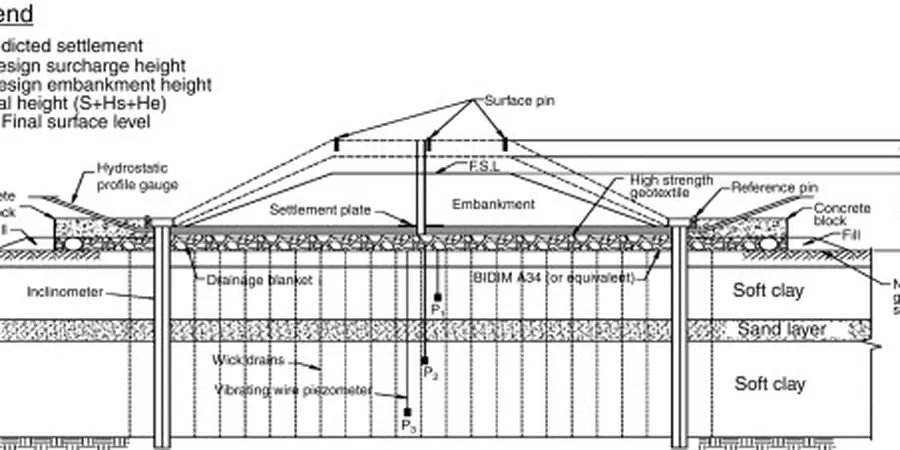
Without surcharge, the preloading timeline is driven entirely by the soil's coefficient of consolidation — we design for measured settlement, not calendar days.
Service characteristics in Burnaby
Typical technical challenges in Burnaby
The mistake we see most often in Burnaby is contractors assuming that preloading without surcharge can be designed with the same consolidation time as a surcharged system. That assumption leads to prematurely removing the fill, only to watch differential settlements crack floor slabs within the first year. The organic silts in the Still Creek and Deer Lake catchments have a coefficient of consolidation (Cv) around 1 to 2 m²/year, which means a 6‑meter clay layer can take over a year to achieve 90 percent consolidation under dead load alone. Without a proper time‑rate analysis, the project schedule becomes the enemy of the ground.
Our services
Alongside our preloading design work, we offer two complementary services that address the specific ground conditions found in Burnaby's soft-soil zones.
Consolidation Analysis & Field Monitoring
We run incremental-load oedometer tests (CSA + CSA + CSA + CSA + ASTM D2435 (also CFEM Ch 2) (also CFEM Ch 2) (also CFEM Ch 2) (also CFEM Ch 2) (also CFEM Ch 2)) on undisturbed samples from boreholes in Burnaby, then apply Terzaghi's one-dimensional theory to predict time‑settlement curves. Field monitoring with settlement plates and vibrating‑wire piezometers lets us recalibrate the model as loading progresses, giving you a data‑backed decision point for fill removal.
Fill Material Sourcing & Compaction Control
We specify and test the borrow material — typically a well‑graded sand‑gravel mix from local pits — to ensure it meets the compaction and drainage requirements for preloading. Our technicians run field density tests (sand cone and nuclear gauge) at each lift to maintain consistent compaction across the entire pad area, preventing soft spots that could lead to differential settlement.
Frequently asked questions
How long does preloading without surcharge typically take in Burnaby's clay soils?
For a 5‑meter layer of Burnaby marine silt or silty clay with a Cv of 1.5 m²/year, reaching 90 percent primary consolidation under dead load alone usually takes 6 to 10 months. The exact duration depends on the drainage path (single vs. double drainage) and the compressibility index (Cc) measured in oedometer tests.
What instrumentation do you recommend for monitoring a preloading project in Burnaby?
We install settlement plates at the ground surface and at the fill surface, plus vibrating‑wire piezometers at the mid‑depth and bottom of the compressible layer. For deeper clay deposits (over 8 meters), we add a deep rod extensometer anchored into the underlying glacial till to separate layer‑by‑layer compression from total settlement.
What is the typical cost range for a preloading design without surcharge in Burnaby?
For a mid‑size commercial pad (0.5 to 1.0 hectare), the engineering design, field instrumentation, and monitoring program for preloading without surcharge typically falls between CA$1,020 and CA$2,620. The final cost varies with the number of boreholes, the complexity of the soil layering, and the duration of post‑load monitoring required.