A 15-story residential tower going up near Metrotown in Burnaby required a deep foundation design. The preliminary boreholes had encountered the sensitive glaciomarine clay that underlies much of the city. Without an oedometer consolidation test, the settlement predictions would have been purely speculative. The project team needed the compression index and preconsolidation pressure to size the piles correctly. That is where our lab stepped in. We ran incremental loading oedometer tests on undisturbed tube samples. The data showed significant overconsolidation from glacial preloading. This allowed the structural engineer to optimize the pile lengths. For similar projects, we often combine the oedometer results with a plate load test to verify modulus values at working stress. The entire process took seven days from sample delivery to final report.
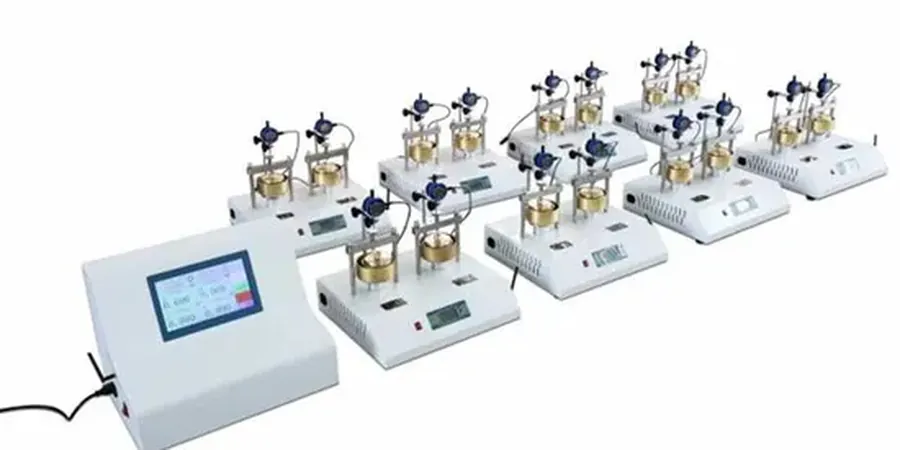
In Burnaby's glaciomarine clays, oedometer data shows preconsolidation pressures ranging from 100 to 400 kPa, critical for settlement control.
Service characteristics in Burnaby
Typical technical challenges in Burnaby
A common mistake contractors make in Burnaby is skipping the oedometer consolidation test on shallow clay layers. They assume the soil is stiff enough based on SPT N-values alone. The N-values in the desiccated crust can read 15 to 25 blows per foot, which seems safe. But below that crust, the soft glaciomarine clay has a liquidity index above 1.0. Without oedometer data, the design might ignore secondary compression. The result is long-term differential settlement that cracks facades and breaks underground utilities. One townhouse development in the Big Bend area saw 80 mm of settlement over three years. The foundation had been designed using only bearing capacity, ignoring consolidation. The oedometer test would have shown the high compressibility of the underlying silt-clay unit.
Our services
We offer a complete range of oedometer consolidation test services in Burnaby, from sample extrusion to final settlement analysis.
Incremental Loading Oedometer (IL)
Standard 24-hour load steps with 8 increments. Provides Cc, Cr, Cv, and σ'p. Suitable for most Burnaby clay projects.
Constant Rate of Strain (CRS) Consolidation
Faster alternative to IL. Uses controlled strain rate. Ideal for low-permeability clays where pore pressure dissipation is slow.
Swelling & Collapse Potential Test
Measures swelling index (Cs) and collapse upon wetting. Critical for sites near Burnaby's creeks or former wetlands.
Settlement Analysis & Report
We compute immediate, primary, and secondary settlement using oedometer data. Includes time-rate curves and recommendations for preloading or wick drains.
Frequently asked questions
What is the difference between an oedometer consolidation test and a triaxial test?
The oedometer test measures one-dimensional compression under zero lateral strain, giving the compression index and coefficient of consolidation. A triaxial test measures shear strength under controlled confining stress. For settlement calculations in Burnaby clay, you need the oedometer. For bearing capacity or slope stability, you need the triaxial.
How long does an oedometer consolidation test take for Burnaby clay?
A standard incremental loading test with 8 increments takes 8 to 10 days for the loading phase. If the clay has low permeability (Cv below 1 m²/year), each step may require 48 hours, extending the total to 14 days. We can use the Constant Rate of Strain method to cut time to 2-3 days.
What is the typical cost of an oedometer consolidation test in Burnaby?
The cost ranges from CA$280 to CA$600 per test, depending on the number of load increments and whether swelling cycles are included. For a standard 8-step IL test with report, expect around CA$450. Volume discounts apply for 5+ tests from the same project.
Can the oedometer test predict secondary compression in Burnaby's sensitive clays?
Yes. The coefficient of secondary compression (Cα) is determined from the slope of the settlement-versus-log-time curve after the primary consolidation is complete. In Burnaby's glaciomarine clays, Cα/Cc typically ranges from 0.02 to 0.05. This data is essential for predicting long-term creep settlement over decades.