With over 230,000 residents and a landscape that transitions rapidly from the Fraser River floodplain to the steep slopes of the Burnaby Mountain conservation area, the city's subsurface conditions vary dramatically in just a few blocks. The field vane shear test (VST) is our primary tool for measuring undrained shear strength in the soft glaciomarine clays and estuarine silts that dominate the lower-lying neighborhoods near the Brunette River and Deer Lake. We deploy this in-situ test according to ASTM D2573-15 to capture the peak and remolded shear strength profiles that laboratory triaxial tests on disturbed samples simply cannot replicate in these sensitive soils. Because Burnaby sits within a moderate seismic zone, understanding the post-peak strength loss — the sensitivity ratio — becomes critical when assessing liquefaction triggering in saturated fine-grained layers. The equipment itself is straightforward: a four-bladed stainless steel vane advanced from a drill rod to a specific depth, rotated at a controlled rate, and the torque recorded at surface. Yet the interpretation demands local experience, especially when peat lenses or discontinuous sand seams interrupt the clay matrix.
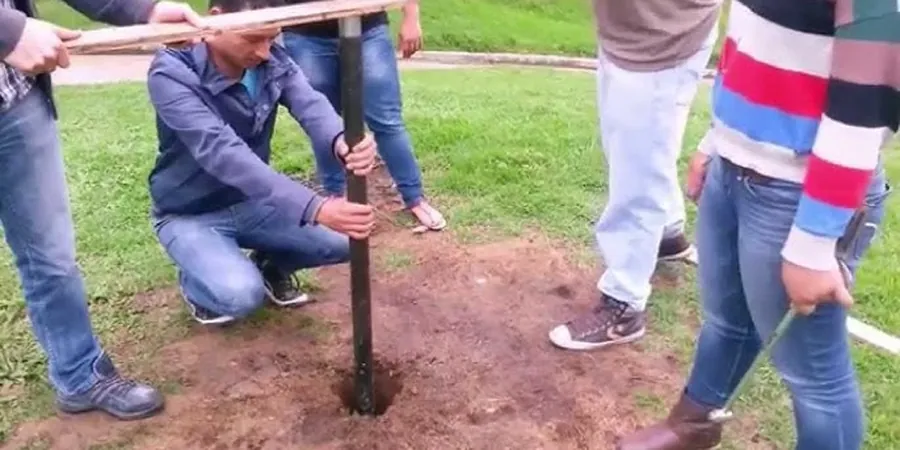
In Burnaby's soft glaciomarine clays, the sensitivity ratio from a field vane test often exceeds 8 — a critical parameter for seismic evaluation and foundation design.
Service characteristics in Burnaby
Typical technical challenges in Burnaby
The rainy season in Metro Vancouver, which concentrates about 60% of annual precipitation between November and February, can saturate the shallow clay crust and produce a misleadingly low peak torque reading if the vane is advanced through a softened zone. Conversely, during the dry summer months, desiccation cracks in the upper 1.5 meters of the clay profile cause artificial strength increases that do not represent the long-term undrained behavior. We mitigate both effects by timing our field vane shear test campaigns to avoid the first 48 hours after heavy rain and by correlating surface moisture content with the depth-specific strength envelope. Another common pitfall in Burnaby is rod friction in the soft organic soils of the Still Creek corridor — if the rods are not rotated at least one full turn before the test, the measured torque includes shaft friction that overestimates vane resistance by 15 to 25 percent.
Our services
We offer two complementary field vane shear test (VST) service packages tailored to Burnaby's geological conditions. Each package includes full ASTM D2573 compliance, on-site engineering supervision, and a certified test report with Bjerrum-corrected strength profiles.
Standard VST Profile (Single Borehole)
Vane tests at 1.5 m intervals from 2 m depth to refusal or to a maximum of 30 m. Includes peak and remolded strength, sensitivity ratio, and rod friction correction. Suitable for low-rise foundation design and slope stability assessment in soft clay deposits.
Advanced VST for Seismic Site Classification
Extended profile with tests every 1.0 m in the upper 10 m, plus vs30/" data-interlink="1">shear wave velocity correlation (VS30) using published regional regressions. Includes site class determination per NBCC 2020 and liquefaction susceptibility screening for saturated fine-grained layers.
Frequently asked questions
How deep can the field vane shear test reach in Burnaby's soft soils?
In the glaciomarine clays typical of the Fraser River floodplain, the practical depth limit is about 30 meters. Beyond that, rod buckling becomes a concern, especially in very soft to medium-stiff clays with undrained shear strengths below 20 kPa. For deeper profiles, we switch to a CPT with seismic measurements.
When is the vane test preferred over a triaxial test on undisturbed samples?
The field vane shear test captures the in-situ undrained strength without the sample disturbance inherent in thin-walled tube sampling of sensitive clays. In Burnaby, where sensitivity ratios can reach 10 or more, the VST provides a more reliable peak strength than any laboratory test on a disturbed specimen. We use triaxial tests mainly for stress-path analysis and stiffness parameters.
What is the typical cost range for a field vane shear test campaign in Burnaby?
For a standard single-borehole profile with tests every 1.5 meters to 20 meters depth, the cost ranges between CA$780 and CA$1.850. The variation depends on site access, depth, number of test points, and whether a drill rig is already mobilized for other borehole work.
How does Burnaby's soil sensitivity affect foundation design?
High-sensitivity clays (St > 8) lose most of their strength when remolded during construction activities such as pile driving or excavation. For shallow foundations in the Big Bend area, we apply a factor of safety of 3.0 on the Bjerrum-corrected vane strength, compared to 2.5 for low-sensitivity clays. This prevents bearing capacity failures during seismic events or heavy rainfall.