A common mistake we see on Burnaby residential projects is assuming that the dark, silty clay underlying much of the city behaves like stable glacial till. That assumption can lead to cracked slabs and misaligned footings within two seasonal cycles. Burnaby's marine-derived clays, particularly those near Deer Lake Park and the Fraser River floodplain, exhibit moderate to high shrink-swell potential when moisture fluctuates. Without an expansive soil evaluation, the plasticity index and free-swell data needed to classify these clays under the Unified Soil Classification System simply don't exist. We have measured PI values above 35% in several Burnaby lots, which places the soil in the high-expansion category. For deep foundations in these zones, combining the evaluation with deep soil mixing can mitigate heave risks effectively.
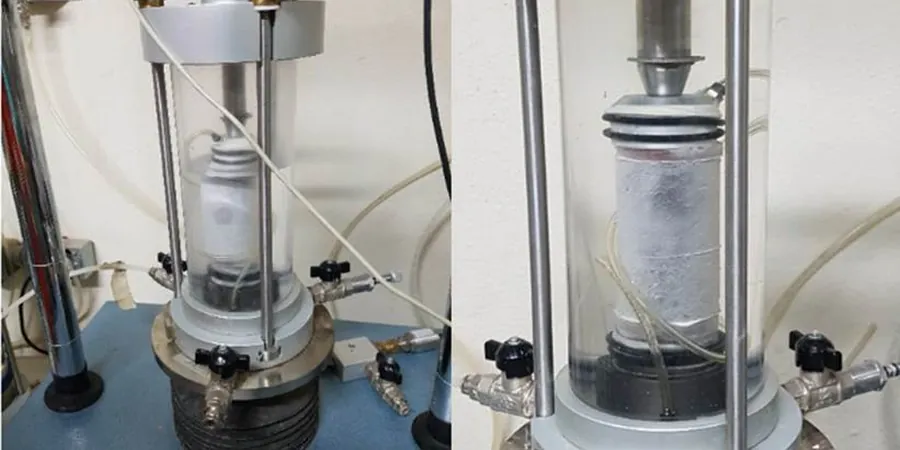
We have measured PI values above 35% in several Burnaby lots, placing the soil in the high-expansion category.
Service characteristics in Burnaby
- Plasticity Index (PI) – values over 25% flag moderate expansion risk
- Free-Swell (%FS) – measured in oedometer under 1 kPa surcharge
- Swell Pressure – often exceeds 50 kPa in Burnaby's clay-rich zones
- Activity Ratio – indicates whether clays are kaolinitic or montmorillonitic
Typical technical challenges in Burnaby
Burnaby sits on the boundary between the coastal temperate rainforest and the drier Fraser Valley, so the seasonal moisture swing is dramatic. Dry summers desiccate the clay profile down to 1.5 m, while winter rains saturate the same depth. That cyclic change drives vertical heave in expansive soils. If the evaluation is skipped, a foundation designed for 25 kPa bearing capacity may experience uplift pressures of 60 kPa or more. The risk is highest on south-facing slopes where evapotranspiration is greatest, and in subdivisions built after clearing mature conifers — trees that previously pumped water out of the clay layer.
Our services
We offer two complementary expansive soil evaluation services tailored to Burnaby's geological conditions.
Index Property Testing for Expansive Soils
Laboratory determination of Atterberg limits, free-swell, and swell pressure on undisturbed tube samples. This package classifies the clay's expansion potential and provides input for structural slab design.
Field Moisture & Suction Monitoring
Seasonal installation of moisture sensors and tensiometers in the active zone (0–2 m depth). Data collected over one wet-dry cycle quantifies actual heave movement and verifies if mitigation measures are working.
Frequently asked questions
How does an expansive soil evaluation differ from a standard geotechnical investigation?
A standard investigation focuses on bearing capacity and settlement. An expansive soil evaluation adds specific swell tests (free-swell, swell pressure, shrinkage limit) and measures the clay's activity ratio to predict vertical movement under moisture change. For Burnaby's marine clays, this distinction is critical because heave often controls foundation design more than bearing capacity.
What is the typical cost range for an expansive soil evaluation in Burnaby?
For a single-family residential lot, the evaluation including sampling, Atterberg limits, and free-swell tests ranges between CA$870 and CA$2,120 depending on the number of boreholes and the laboratory testing volume. Larger commercial sites with multiple test pits or seasonal monitoring fall at the upper end of that range.
Can expansive soils be treated without replacing the entire foundation?
Yes. Common mitigation methods include moisture control through surface drainage and perimeter gutters, chemical stabilization with lime or cement, and mechanical measures like over-excavation of the active zone. In Burnaby, we often specify a granular capillary break beneath the slab combined with a flexible foundation system that can tolerate minor movement.